
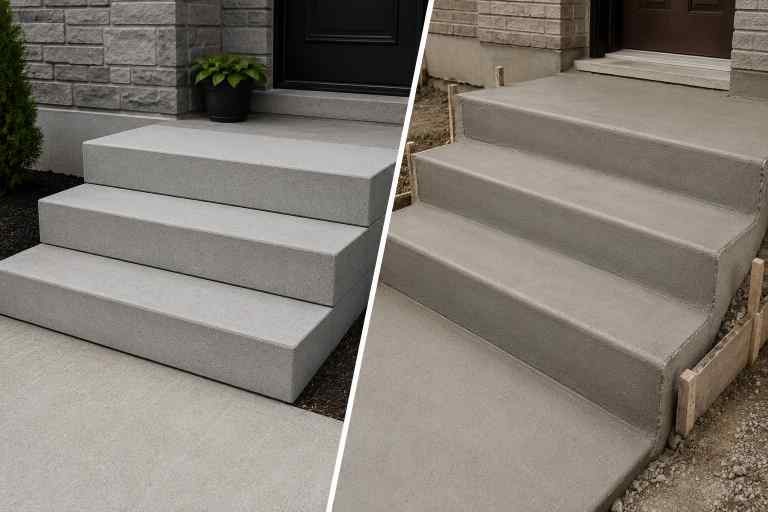
The main difference lies in how and where they’re constructed: precast steps are manufactured off-site and delivered ready to install, while poured steps are built directly at your location. This post compares these two options based on cost, installation, customization, and long-term performance.
When it comes to choosing between precast concrete steps and poured concrete steps, both offer durable solutions depending on your specific needs. A precast concrete step’s condition depends on is builders. From so many builders the best precast concrete steps builder near you can provide the service as per your needs.
What are the Difference Between Precast Concrete Steps and Poured Concrete Steps
Precast concrete steps are pre-manufactured in a controlled facility and delivered as a finished unit, making them faster to install and often more affordable upfront. Poured concrete steps, by contrast, are formed and cured on-site, offering greater flexibility in shape and size but requiring more time, labor, and cost. The core distinction lies in factory-made precision versus on-site customization.
What are the Feature Comparisons between Precast Concrete Steps vs Poured Concrete Steps?
| Feature / Factor | Precast Concrete Steps | Poured Concrete Steps |
| Use Case | Best for quick installs and modular applications | Ideal when exact custom sizing is needed |
| Cost / Budget | Typically costs less upfront | Usually priced higher due to labor and curing time |
| Customization | Limited to available molds | Highly customizable in shape and finish |
| Ease of Use | DIY-friendly with crane or forklift | Requires experienced concrete crew |
| Setup / Installation | Delivered ready-to-install | Requires on-site framing and curing |
| Long-Term Flexibility | Portable and replaceable | Permanent and seamlessly integrated |
What are the Key Strength and Use Cases of Precast Concrete Steps?
Precast concrete steps are ideal for homeowners or contractors seeking a quick, efficient, and cost-effective stair solution. Because they are made off-site, they offer consistent quality and require less downtime during installation. These steps work best for modular building applications, fast remodels, or projects with limited site access. Precast is perfect for those prioritizing speed and uniformity over intricate customization.
Cast in place vs precast concrete for foundations have some pros and cons and you need know them properly before taking any decisions.
What are the Key Strengths and Use Cases of Poured Concrete Steps?
Unlike precast steps, poured concrete steps are tailored on-site to fit any unique layout or design. This method excels in projects that demand custom shapes, integrated designs, or specialized finishes. It’s better suited for high-end residential, landscape-integrated stairs, or locations where permanent structural integration is essential. Choose poured steps if you value precision and aesthetic customization over speed.
How much is the difference in cost between Precast vs Poured Concrete Steps?
- Precast Concrete Steps:
- Upfront Cost: $800 – $1,500 depending on size and style
- Installation Cost: Lower due to minimal labor needs
- Maintenance: Low; typically sealed during production
- Poured Concrete Steps:
- Upfront Cost: $1,200 – $2,500 or more based on complexity
- Installation Cost: Higher due to on-site labor and longer setup
- Maintenance: May require sealing or repairs over time
What are the Pros and Cons of Precast Concrete Stairs?
Pros:
- Quick installation with minimal site preparation
- Lower upfront cost and predictable pricing
- Factory-made quality control ensures consistent results
- Portable and replaceable, suitable for modular buildings
Cons:
- Limited customization due to fixed mold options
- May require crane or forklift for delivery
- Less adaptable to non-standard layouts
In this regard, precast steps are best for those valuing speed and budget control.
What are the Pros and Cons of Poured Concrete Steps?
Pros:
- Highly customizable in shape, size, and finish
- Ideal for complex site conditions and landscape integration
- Offers a seamless, permanent structure
Cons:
- Higher labor and material costs
- Longer setup time due to on-site curing
- Requires skilled professionals for proper installation
However, in this case, poured steps excel in high-end or detailed architectural designs.
What are the differences between DIY Poured Concrete Stairs vs Precast Options?
Precast options are more DIY-friendly, especially when access to lifting equipment is available. They arrive ready-made and can be installed quickly without professional concrete finishing skills.
DIY poured concrete stairs, on the other hand, demand advanced knowledge, including formwork setup, mixing ratios, and curing procedures. Moreover, mistakes in poured concrete can lead to uneven treads or cracking.
In summary, choose precast if you want a reliable DIY path. Opt for poured only if you have experience or hire a pro.
Which One Should You Choose from Precast and Poured Concrete Steps?
- If you need a fast, cost-effective solution with minimal site disruption, go with precast concrete steps.
- If you prefer a fully customized, seamless design that integrates with your space, choose poured concrete steps.
- For long-term value in a high-end or architecturally complex project, poured is the better investment.
- For rental properties, modular buildings, or quick renovations, precast is likely the smarter choice.
Conclusion:
The core difference lies in installation method and customization. Precast concrete steps are factory-made, consistent, and fast to install, making them ideal for quick-turn projects. Poured concrete steps offer design flexibility and permanence, better for tailored builds. Choose based on your goals—whether that’s speed, budget, customization, or long-term performance.
FAQ
Q: What is the main difference between precast and poured concrete steps?
A: Precast steps are best for fast installs and uniform designs because they’re made off-site. Poured steps are better when you need custom shapes or integrated aesthetics.
Q: Is precast cheaper than poured concrete?
A: It depends. Precast usually has a lower upfront cost, but poured concrete may offer better value in the long run depending on usage.
Q: Can I switch from precast to poured later?
A: In some cases yes, but it may require reworking the site and foundation if the systems are not directly compatible.
Q: How long do precast concrete steps last?
A: With proper maintenance, precast concrete steps can last 50 years or more.
Q: Are precast concrete stairs better than poured?
A: It depends on your needs. Precast is better for speed and cost, while poured is better for custom fit and aesthetics.
Q: What are modular precast concrete steps?
A: These are factory-made stair units designed for quick assembly and easy transport, often used in modular buildings or prefabricated structures.