
Making the wrong choice between repair and replacement costs you money. A patch on a failing slab is money wasted. A full replacement on a slab that only needed sealing is money wasted too. The right decision depends on what type of damage you have and what the ground underneath looks like. This guide walks through five common driveway situations and explains what the right fix is for each one.
Can You Fix a Cracked Concrete Driveway Without Replacing the Whole Thing?
Yes. You can fix minor surface cracks and small chips without tearing out the whole driveway. The key condition is that the ground underneath must still be firm and solid.
Surface cracks that are less than one-quarter inch wide are considered cosmetic. They do not go all the way through the slab. They do not mean the base is failing. We clean these cracks out and fill them with a polymer-modified repair mix. After the fill is troweled smooth, we spray the patched area with ASTM C309 liquid membrane-forming curing compound. This product seals the surface and locks moisture inside the repair so it cures all the way through. For larger areas of surface damage, we first cut clean, straight edges around the damaged zone using an early-entry walk-behind concrete joint saw. This tool lets us remove only the damaged concrete and pour a fresh section with a clean bond line. All repair work done in California summer heat follows the American Concrete Institute (ACI) 305R (Guide to Hot Weather Concreting). This standard tells us exactly how to protect fresh concrete when the air temperature goes above 77 degrees Fahrenheit.
What Kind of Damage Is Too Severe to Patch?
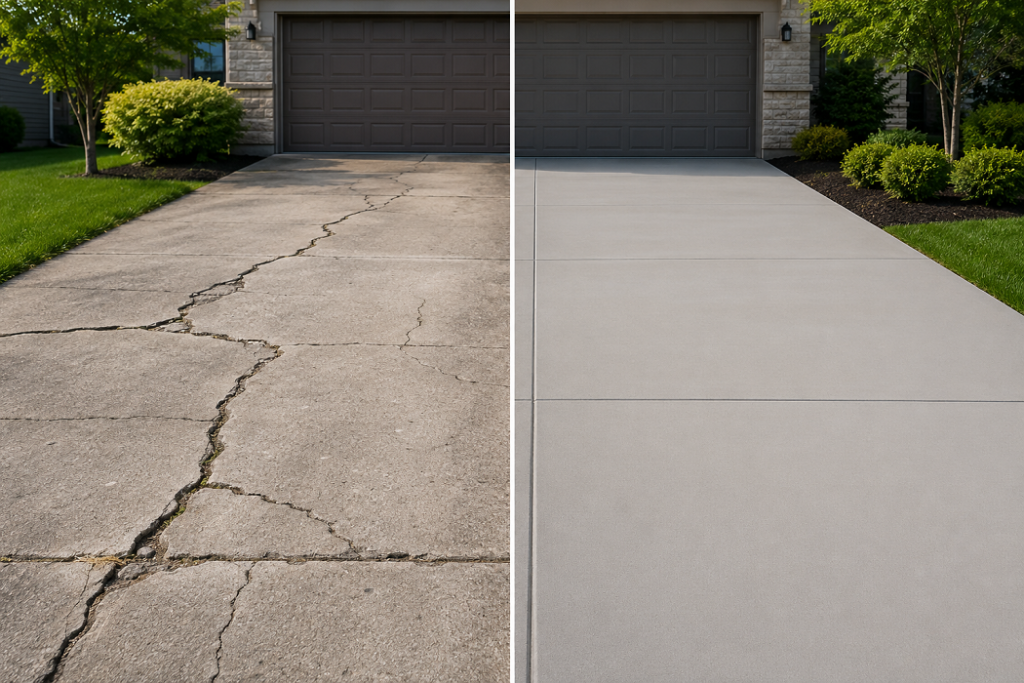
Cracks wider than one-quarter inch usually go all the way through the slab. Cracks that run diagonally across a corner, or cracks that form a web pattern across a section, are signs the slab is breaking from the inside. These need removal, not patching.
How Long Does a Good Surface Patch Last?
A properly applied patch on a firm, stable base lasts 10 to 15 years. A patch applied over soft or shifting soil will fail in one to two years because the ground movement will pull the repair apart from below.
What Does It Mean When Your Driveway Is Sinking or Rising?
A sinking or rising driveway means the soil underneath it is shifting. This is a ground problem, not a concrete problem. Patching the surface will not fix it.
In most of California’s Central Valley, the cause is the native expansive San Joaquin clay loam soil. This clay absorbs water during winter rain and swells. Then the summer heat dries it out and it shrinks back down. Each cycle leaves a slightly different gap pattern under the concrete. Over several years, sections of the slab end up with no ground support beneath them. When a car drives over these sections, they flex and crack. To find out how deep the soil problem goes, we use a dynamic cone penetrometer. This device is pushed into the soil in controlled steps. Each step tells us how much resistance the soil gives at that depth. Soft zones show up clearly and tell us whether the soil can be treated or must be replaced. This soil check is required under the California Building Code (CBC) Title 24, Part 2, Section 1803 (Geotechnical Investigations). This section of the code mandates ground testing on any project built in areas with known soil movement.
Can You Lift a Sunken Slab Without Replacing It?
Sometimes. A process called slab jacking pumps a cement slurry under the slab to fill voids and raise it back to level. This works when the slab itself is in good condition and the void is small. It does not work if the concrete is already cracked through or if the soil problem covers a large area.
How Do You Replace Just One Section Without the Joint Failing?
You replace one section by connecting it to the existing slab with steel bars before pouring. Without this connection, the two slabs will move independently and create a dangerous raised lip at the joint within a few seasons.
We cut the damaged section out with a concrete saw and remove it. Then we drill holes into the edge of the old slab and insert short lengths of Grade 60 steel rebar, #4 bar size, into the holes using structural epoxy. These bars stick out into the new pour area and anchor the new concrete to the old. Next, we build the rest of the rebar grid inside the form and tie every crossing point using a manual rebar tying tool. This tool fastens each joint with a short wire twist in seconds. Also, keeping the grid tied prevents bars from shifting during the pour. Our sectional replacement process follows the structural rules of the California Building Code (CBC) Title 24, Part 2, Section 1907 (Slab-on-Ground Minimums). This code defines the required bar size, spacing, and position for all residential concrete slabs built in California.
Why Do Some Sectional Replacements Fail Quickly?
The most common reason is skipping the steel dowels. Without dowels, new concrete has no physical connection to the old slab. The two sections settle at different rates because they sit on different amounts of compacted base. Within two years, one side sinks and creates a trip hazard at the joint.
When Does the City Require You to Rebuild the Driveway Approach?
The city requires you to rebuild the approach when the joint between the driveway and the public sidewalk rises more than one-quarter inch. California classifies this as a trip hazard. The city has the right to issue a notice requiring you to fix it.
Rebuilding the approach means removing the old concrete, digging down to the subgrade, and starting fresh. We first spread a four-inch layer of Class 2 aggregate base over the compacted subgrade. This crushed rock base creates a firm, even platform that spreads vehicle weight across a wide area. Then we compact it using a reversible vibratory plate compactor. This machine uses vibration and downward force to pack the gravel until it locks together. Without this compaction step, the new approach concrete will settle unevenly and create the same trip hazard within a few years. All approach work in the public right-of-way must comply with the City of Sacramento Standard Construction Specifications Drawing T-14 (Driveway Approach Standard). This document gives the exact thickness, base depth, and slope required for every residential driveway approach in the city.
Who Is Responsible for the Driveway Approach?
The approach is on public land, but in most California cities the homeowner is responsible for building and maintaining it. If the city issues a notice to repair, the homeowner must hire a licensed contractor to do the work within the specified deadline.
How Do You Stop Water from Pooling on Your Driveway After Repair?
You stop water from pooling by grading the driveway surface to drop at least two percent away from the house, and by adding underground pipes to carry runoff away from the slab edges.
If standing water is the reason your driveway failed in the first place, you must fix the drainage during the replacement. Skipping this step means the new driveway will fail for the same reason. We install Schedule 40 PVC drainage pipe in a trench along the driveway edge. This rigid pipe collects water from the surface and carries it to a safe discharge point. Then we pack the soil tightly around the pipe using a heavy-duty steel hand tamper. This tool is narrow enough to work in tight trenches where a plate compactor cannot fit. Loose soil around the pipe will settle and cause the pipe to sag. A sagging pipe holds standing water instead of draining it. This grading and drainage work is required by the California Residential Code (CRC) Section R401.3 (Foundation Drainage). This code requires all impervious surfaces within ten feet of a house to shed water away from the building at a minimum two percent slope.
What Is the Fastest Sign That Drainage Is Causing the Damage?
Look at where the cracks appear most. If they consistently form along the edges of the driveway or near the garage door, water is likely collecting there and weakening the base from below. Fixing the crack without fixing the water flow will not solve the problem.
Not sure whether to repair or replace your California driveway? Contact Sacramento Concrete Contractor for a free inspection. We check the concrete, test the soil, and give you a straight answer on what the right fix is.
Call us: (916) 555-0199
Service Area: Sacramento, Elk Grove, Roseville, Folsom, Rancho Cordova, and communities across California.